Pain while walking X-ray
Date: 2026-05-05
Accepted answers: Gout
Explanation
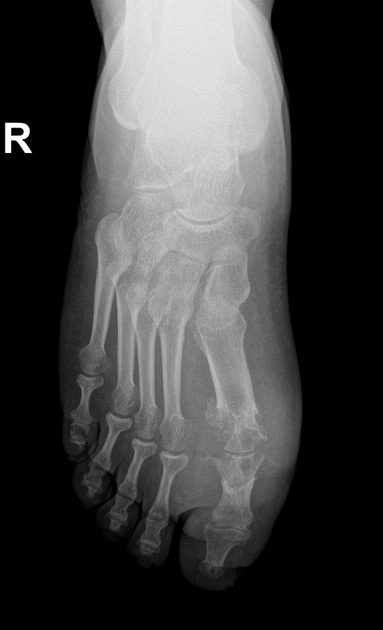
Radiographs reveal juxta-articular erosions with the pathognomonic overhanging edge and a hyperdense tophus at the first MTP joint the hallmark of chronic tophaceous gout. Monosodium urate crystal deposition incites a granulomatous inflammatory response that destroys periarticular bone while characteristically sparing the joint space until late disease. Diagnosis is confirmed by negatively birefringent needle-shaped crystals on polarized light microscopy of aspirated synovial fluid. Management involves acute flare suppression with NSAIDs, colchicine, or corticosteroids, and long-term urate-lowering therapy with allopurinol or febuxostat.
Source: Bekele A, Gouty arthritis. Case study, Radiopaedia.org (Accessed on 05 May 2026) https://doi.org/10.53347/rID-234556
Hints
- A 35-year-old male presents with three years of progressive right foot pain and swelling, with episodes of acute severe joint inflammation that have become persistent over time.
- The first MTP joint is swollen, warm, and tender, with a firm, chalky-white subcutaneous nodule palpable overlying the joint and restricted range of motion.
- The patient consumes a diet rich in red meat, shellfish, and alcohol; serum uric acid is 9.8 mg/dL; and prior synovial fluid aspiration revealed negatively birefringent, needle-shaped crystals under polarized light.
- Radiographs demonstrate a hyperdense soft tissue mass overlying the first MTP joint with well-defined periarticular erosions bearing a characteristic overhanging cortical edge, while the joint space remains preserved.
- This condition affects middle-aged men with hyperuricemia, with monosodium urate crystals precipitating at distal cool joints and causing tophaceous deposits that erode bone while relatively sparing articular cartilage.
- A lobulated hyperdense periarticular soft tissue mass overlies the first MTP joint, with punched-out juxta-articular osseous erosions exhibiting overhanging periosteal lips, preserved joint space, and absent periarticular osteopenia.