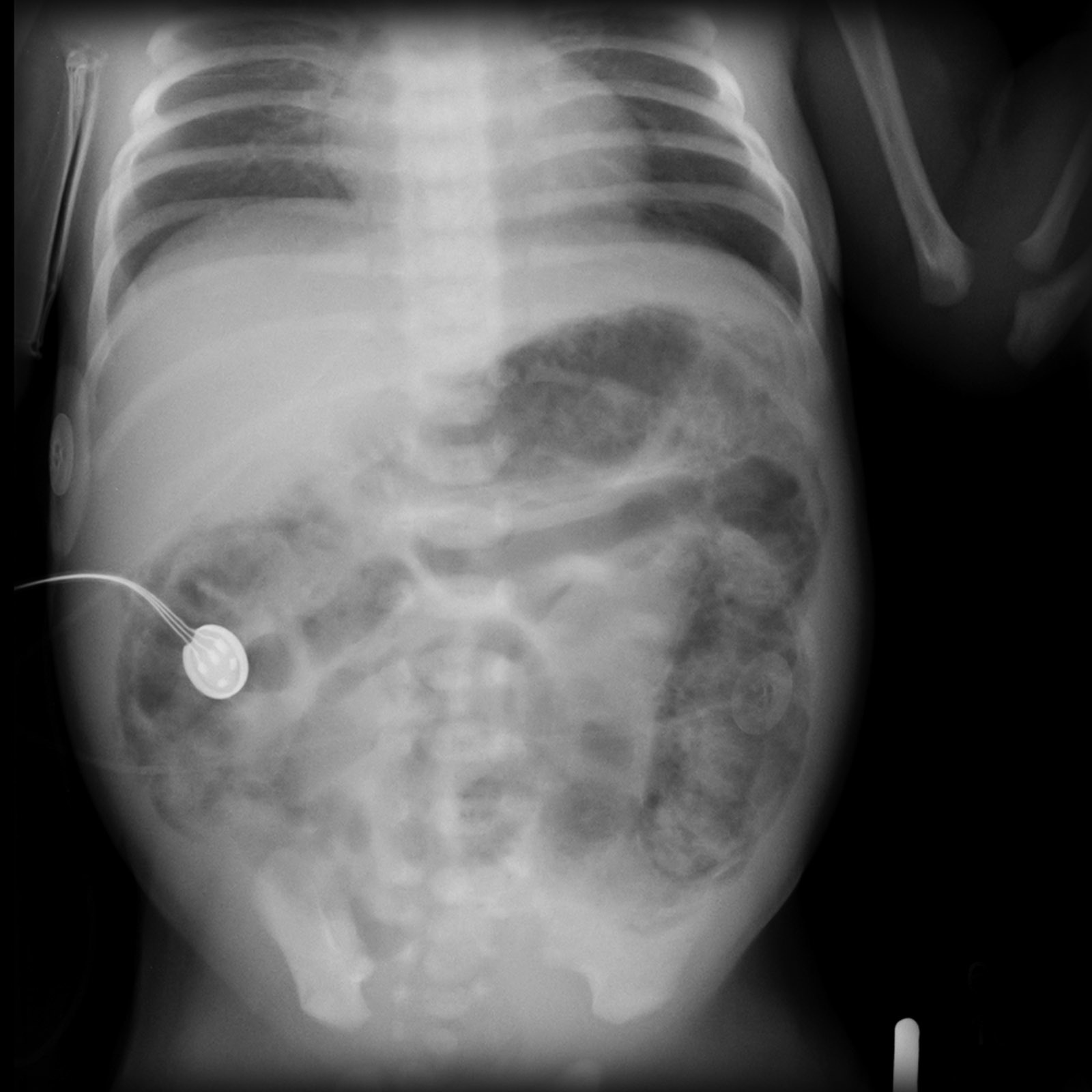
New Born issues X-ray
Date: 2026-04-07
Accepted answers: Necrotizing enterocolitis
Explanation
The X-ray above shows pneumatosis intestinalis — bubbly, cystic lucencies within the bowel wall — which is the radiographic hallmark of this condition and results from gas-forming bacteria infiltrating the ischemic and inflamed intestinal mucosa. The markedly distended bowel loops reflect a paralytic ileus driven by transmural inflammation and sepsis. In the clinical context of a neonate with feeding intolerance, bloody stools, and systemic instability, this imaging finding is essentially pathognomonic and mandates immediate NPO status, IV antibiotics, and surgical evaluation. The progression to free air (pneumoperitoneum) signals full-thickness bowel necrosis and perforation, representing the point at which emergent surgical intervention becomes unavoidable.
Source: Gaillard F, Necrotizing enterocolitis. Case study, Radiopaedia.org (Accessed on 07 Apr 2026) https://doi.org/10.53347/rID-6355
Hints
- The infant develops progressive abdominal distension, bilious vomiting, and bloody stools within the first 72 hours of life, accompanied by increasing lethargy and temperature instability.
- On physical examination, the abdomen is tense and diffusely tender to palpation, with the overlying skin appearing erythematous and edematous, particularly in the right lower quadrant.
- Although this infant is term, he had a complicated delivery requiring resuscitation at birth, raising concern for an ischemic insult to a particularly vulnerable segment of the gastrointestinal tract.
- CBC reveals thrombocytopenia and a left-shifted leukocytosis; metabolic acidosis is noted on ABG, and serial abdominal exams show rapid progression over 6 hours.
- The abdominal radiograph demonstrates markedly dilated bowel loops with a bubbly or mottled lucency tracking within the bowel wall itself, a finding that represents gas produced by bacterial invasion of the intestinal mucosa
- The surgical team is urgently consulted when a repeat X-ray reveals a new collection of free air under the diaphragm, indicating that the compromised bowel has progressed to its most feared complication.