Foot Issue X-ray
Date: 2026-03-25
Accepted answers: Calcaneal fracture
Explanation
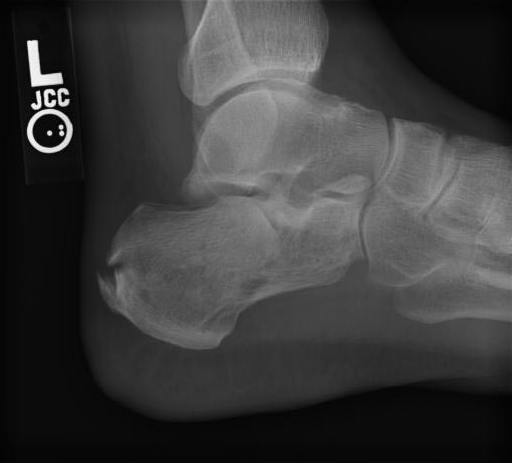
Calcaneal fracture is a fracture of the calcaneus most commonly resulting from axial loading, such as a fall from height (e.g., ladder, roof). It is the most common tarsal bone fracture. On lateral X-ray, the key finding is a decreased Böhler angle (normally 20–40°), reflecting collapse of the posterior calcaneus. The fracture may be intra-articular and often comminuted. Patients present with heel pain, swelling, ecchymosis, and inability to bear weight. Because of the high-energy mechanism, calcaneal fractures are classically associated with lumbar spine compression fractures, so evaluation of the spine is recommended. Management depends on severity and displacement, ranging from immobilization and non-weight-bearing to surgical fixation for displaced or intra-articular fractures.
Source: Radswiki T, Knipe H, Campos A, et al. Calcaneal fracture. Reference article, Radiopaedia.org (Accessed on 25 Mar 2026) https://doi.org/10.53347/rID-12879
Hints
- A patient presents following a fall from height with severe heel pain and inability to bear weight.
- Lateral foot radiographs are obtained to evaluate for osseous injury.
- The imaging demonstrates loss of the normal Böhler angle (<20°), with flattening of the calcaneus.
- There is comminution and depression of the posterior facet of the calcaneus.
- Additional imaging may be obtained to assess for associated injuries given the mechanism.