Incidental Findings X-ray
Date: 2026-03-23
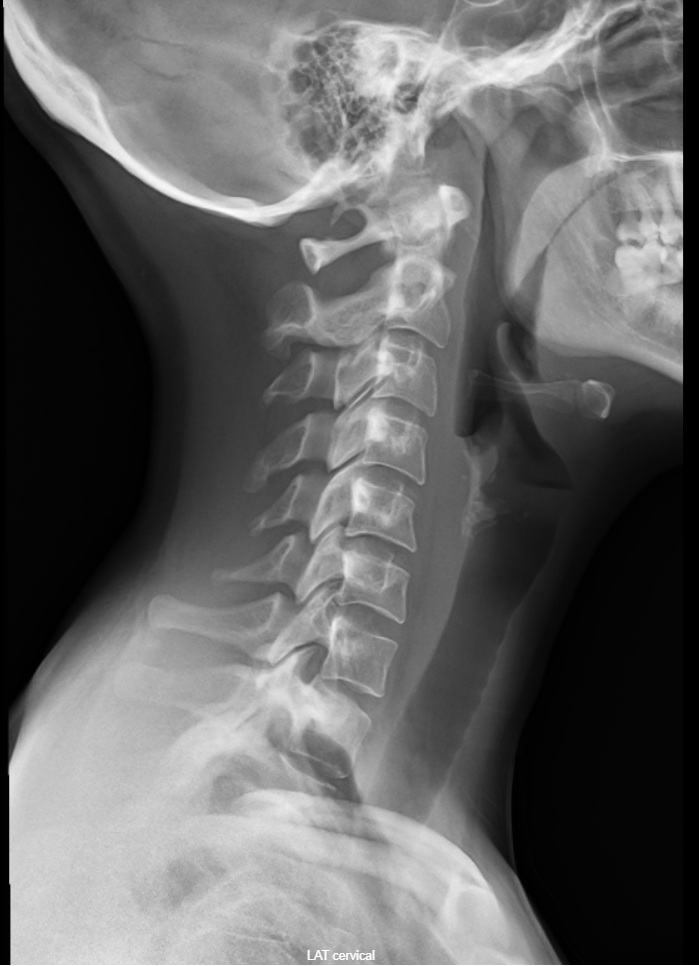
Accepted answers: Arcuate foramen
Explanation
The arcuate foramen is a benign anatomic variant of the C1 vertebra characterized by an incomplete bony bridge (ponticulus posticus) on its posterior aspect. The vertebral artery courses through or adjacent to this foramen, and while usually asymptomatic, it can rarely contribute to vertebrobasilar insufficiency with certain head positions. Recognition as a normal variant is essential to prevent unnecessary intervention or misinterpretation as pathology on trauma imaging.
Source: Luna Morales O, Arcuate foramen. Case study, Radiopaedia.org (Accessed on 23 Mar 2026) https://doi.org/10.53347/rID-231578
Hints
- A 25-year-old female presents to the emergency department with acute-onset cervical neck pain and limited range of motion following a motor vehicle collision. Neurologic examination is intact with no focal deficits, weakness, or sensory changes.
- Plain radiographs of the cervical spine are obtained for trauma clearance. On the lateral view, no acute fracture, subluxation, or significant canal narrowing is identified; alignment appears preserved.
- CT imaging of the cervical spine with sagittal and coronal reconstructions is performed for further evaluation. The atlas (C1 vertebra) is intact without fracture; however, there is no history of cervical pathology, developmental delay, or previous spinal surgery.
- High-resolution imaging demonstrates a small, symmetric bony notch or foramen on the posterior lateral mass of the C1 vertebra, with the vertebral artery coursing adjacent to this anatomic variant.
- Repeat imaging or 3D reconstructions confirm the finding is bilateral and symmetric, with no mass effect on the spinal canal, no compression of neural elements, and no associated edema or signal change on MRI.
- The part of intrest is an incidental anatomic variant of the atlas encountered in 5-10% of the population, representing an incomplete ossification of the ponticulus posticus. It is typically asymptomatic and requires no intervention, though rarely it may be associated with vertebral artery compression during extreme head rotation.