3 Year Old With Cough X-ray
Date: 2026-03-16
Accepted answers: Croup (laryngotracheobronchitis)
Explanation
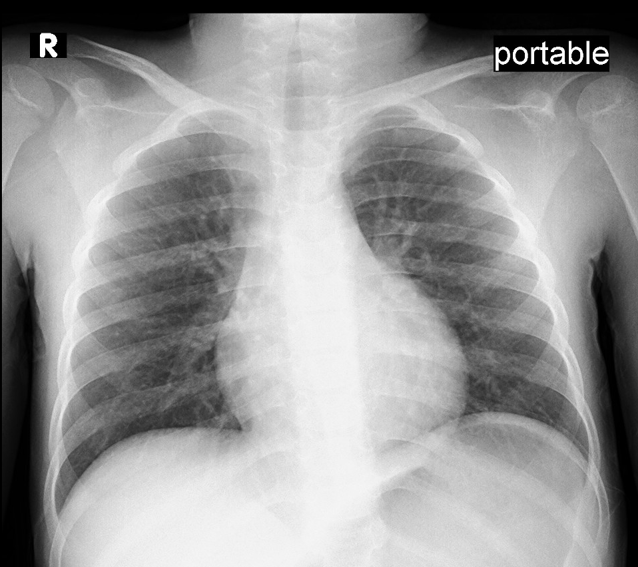
Croup (or Laryngotracheobronchitis) is a respiratory disease that typically presents in children under 6 years old due to inflammation and swelling of the subglottic regions leading to upper airway obstruction.. It is often preceded by an URI by a few days with onset of Croup typically occurring at night while sleeping. It is characterized by a distinctive "barking" cough, inspiratory stridor, hoarseness, and varying degrees of breathing difficulty caused by the upper airway obstruction. Demographics: Although croup can occur in any young child, it is most common in those 6 months to 3 years of age, affecting about 3% of children each year. Etiology: The parainfluenza virus accounts for roughly 75% of cases. Course: In most children, symptoms are self-limited and resolve within about 48 hours, though mild cough may persist slightly longer. Radiology: While diagnosis is often clinical, it is supported by the "steeple sign" finding produced by narrowing of the subglottic region within the trachea Treatment: Corticosteroids, namely dexamethasone, are used to reduce airway inflammation and swelling, though their therapeutic effect is not immediate. Nebulized racemic epinephrine is used in more severe cases of respiratory distress (ex: inspiratory stridor while at rest) due to the alpha-adrenergic effects causing vasoconstriction to decrease the swelling within the trachea Differentials: It is important to differentiate croup from other potentially serious causes of upper airway obstruction such as bacterial tracheitis or acute epiglottitis -Epligottis: Sudden drooling, dysphagia (difficulty swallowing), muffled “hot potato” voice, inspiratory stridor, sitting leaning forward (“tripod”). Thumbprint sign on lateral neck xray -Bacterial Tracheitis: Barking cough, stridor, high fever, toxic appearance, sometimes purulent secretions; does NOT improve with epinephrine. Can also have steeple sign on chest xray
Source: Ibrahim O, Croup (inverted V sign). Case study, Radiopaedia.org (Accessed on 15 Mar 2026) https://doi.org/10.53347/rID-230756
Hints
- 3 year old male with history of Asthma presents to the ED for cough and difficulty breathing
- Child had a fever with runny nose for 2 days prior, then suddenly developed trouble breathing last night while sleeping
- At home, symptoms did not improve after the patient used his albuterol inhaler
- ED Note respiratory exam was significant for cough, inspiratory stridor, nasal flaring, and substernal retractions
- Symptoms improved after administration of dexamethasone and nebulized racemic epinephrine
- Chest XRay was significant for "steeple sign" in the trachea. ED note respiratory exam was updated to characterize the cough as "barking"