Crying Baby Ultrasound
Date: 2026-03-15
Accepted answers: Cholelithiasis
Explanation
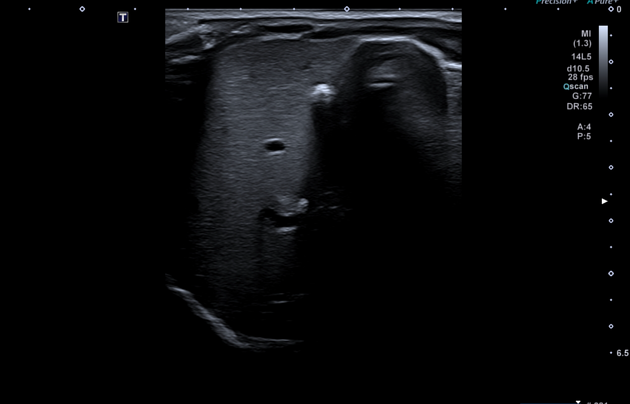
Explanation Cholelithiasis is uncommon in infancy and rare in the neonatal period, with recognized risk factors including hemolytic disease (e.g., hereditary spherocytosis, sickle cell), prematurity, prolonged parenteral nutrition, sepsis, and furosemide use — though as in this case, it may occur in otherwise healthy term infants without identifiable cause. Abdominal ultrasound is the modality of choice and demonstrates echogenic intraluminal foci with posterior acoustic shadowing within the gallbladder, which may appear contracted or collapsed around the stones. The persistence of findings after a fasting interval distinguishes true calculi from sludge or artifactual echogenicity. Management in healthy infants is typically conservative with watchful waiting, as spontaneous resolution has been documented; surgical intervention is reserved for cases complicated by cholecystitis, biliary obstruction, or persistent symptoms refractory to expectant management.
Source: Hussin N, Gall bladder calculi in an infant. Case study, Radiopaedia.org (Accessed on 15 Mar 2026) https://doi.org/10.53347/rID-231108
Hints
- A 2-month-old female presents with inconsolable crying, irritability, and poor feeding.
- There is no fever or focal abdominal tenderness on examination; the abdomen is soft without guarding, and the infant appears otherwise well-nourished and without dysmorphic features.
- No family history of hemolytic disease is identified, the infant was born at term, and there is no history of prolonged parenteral nutrition or prior illness.
- Abdominal ultrasound demonstrates a contracted, thick-walled gallbladder with a hyperechoic focus measuring approximately 4.3 mm in the gallbladder fossa casting posterior acoustic shadowing.
- Repeat ultrasound performed after two days of fasting demonstrates persistence of the contracted gallbladder and the shadowing intraluminal echogenic focus, with no interval change in size or position.
- The finding is encountered rarely in the neonatal and early infant period, most often arising in the setting of hemolytic anemia, prematurity, or metabolic disturbance, though it may also occur in otherwise healthy term infants and can resolve spontaneously with conservative management.