Pain in the Hands X-ray
Date: 2026-03-06
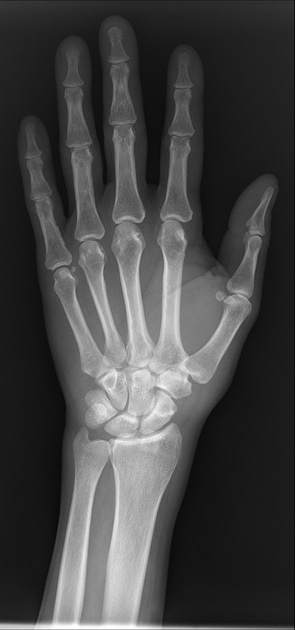
Accepted answers: Scaphoid fracture
Explanation
The scaphoid is the most commonly fractured carpal bone, typically occurring after a fall onto an outstretched hand. Waist fractures account for approximately 70% of scaphoid fractures and carry a risk of avascular necrosis due to the retrograde blood supply to the proximal pole. Dedicated scaphoid views (including ulnar deviation views) are essential for diagnosis as the fracture may be occult on standard wrist radiographs. Treatment options include immobilization with thumb spica casting for non-displaced fractures or surgical fixation with a Herbert screw for displaced fractures, active individuals, or to expedite healing. Follow-up imaging is critical to assess for healing or complications such as non-union or avascular necrosis.
Source: Ranchod A, Scaphoid fracture and Herbert screw fixation. Case study, Radiopaedia.org (Accessed on 06 Mar 2026) https://doi.org/10.53347/rID-229825
Hints
- A 50-year-old male presents to the emergency department following blunt trauma to the left wrist.
- The patient reports falling onto an outstretched hand (FOOSH injury).
- Physical examination reveals tenderness in the anatomical snuffbox and pain with axial loading of the thumb.
- Standard wrist radiographs show subtle findings that are difficult to appreciate on routine AP and lateral views.
- Dedicated scaphoid series radiographs demonstrate a radiolucent line through the mid-portion of the carpal bone on the radial aspect of the wrist, with regional soft tissue swelling but no displacement.
- The fracture line traverses the narrow waist region of this bone, which has a retrograde blood supply making it prone to avascular necrosis if left untreated.